Textual Analysis of Shakespeare’s ‘King Lear’
For this midterm, I chose to do textual analysis of Shakespeare’s play King Lear using Voyant Tools, building on the techniques we’d discussed on fourth Thursday. I uploaded the XML files of King Lear and Shakespeare’s collected sonnets separately from each other.
I was interested in seeing whether some of the particularities of Elizabethan ideas about family identified by scholars like Stephen Collins in his 2016 doctoral thesis “The Moral Basis of Family Relationships in the plays of Shakespeare and his Contemporaries: a Study in Renaissance Ideas” (link) and Gwyn Daniel’s 2018 book Family Dramas: Intimacy, Power and Systems in Shakespeare’s Tragedies (link) would shine through if I used a software like Voyant to do some textual analysis.
I spent most of Tuesday afternoon trying out different tools for visualizing the play. Personally, I found that the “Links” tool was the most helpful. I wanted to highlight associations between different words or different characters. However, the “Bubblelines” tool was also helpful to give a sense of changing word frequency over time.
I was surprised that the seven most central, frequently used terms in a play known for its family drama didn’t include the name of any one of King Lear’s three daughters: Regan, Goneril, and Cordelia.
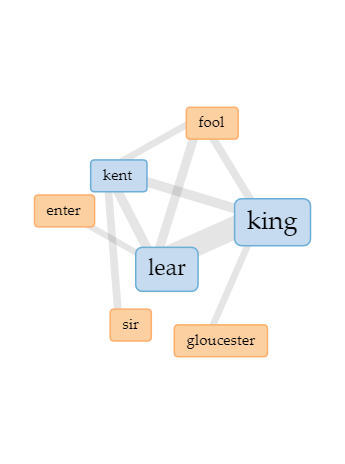
However, even though I found this surprising, it does fall in line with Collin’s assessment of Elizabethan ideas about love and duty to family. He concludes that although from a modern perspective we may find Regan and Goneril, who prioritize themselves and their husbands over their father’s wellbeing, Elizabethans prioritized obedience to, not love of one’s parents, and expected marital vows to take precedence once one reached adulthood.
Loving one’s parents, however, was a less obvious expectation. There was a duty to “love, honour, and succour my father and mother” set out in the Catechism, but only as one example of loving one’s neighbours, and there was no general assumption that relationships between parents and their children were necessarily reciprocal.
Collins, pp. 9 of “The Moral Basis of Family Relationships in the plays of Shakespeare and his Contemporaries: a Study in Renaissance Ideas.” PhD diss., University of York, June 2016.
For comparison’s sake, I ran an analysis of a complete collection of Shakespeare’s sonnets, which were written over the course of his career and by and large consisted of love poems. I found this visualization to be much more inline with my preconceptions about Shakespeare’s work–lots about beauty and love, tempered by the author’s awareness of his mortality and the passing of time.
At first glance, the traditional method of close-reading may seem to be at odds with the more “data-focused” approach of Voyant Tools. Daniel (2018) and Collins’ (2016) readings have a clear advantage when it comes to picking up on nuance and some of the more structural elements of the play. However, the bird’s eye view of King Lear provided by using Voyant Tools allows the non-specialist user (or even casual Shakespeare enthusiast) to see broader patterns and links within the body of the play that would otherwise be much more difficult to spot. I did have similar concerns about different tools (especially the Bubbleline tool, which uses extremely similar colors) not being the most accessible for color-blind users while completing the midterm as I did when we first encountered the tools in class, but I think that it’s still a really useful piece of software. Furthermore, Voyant is exceptionally user-friendly thanks to its intuitive, easy-to-learn approach that prioritizes allowing the users to manipulate different styles of visualized text analysis.
Works Referenced
Daniel, Gwyn. 2018. Family Dramas: Intimacy, Power and Systems in Shakespeare’s Tragedies.
Collins, Stephen David. “The Moral Basis of Family Relationships in the plays of Shakespeare and his Contemporaries: a Study in Renaissance Ideas.” PhD diss., University of York, June 2016.
Shakespeare, William. 1606. King Lear.
